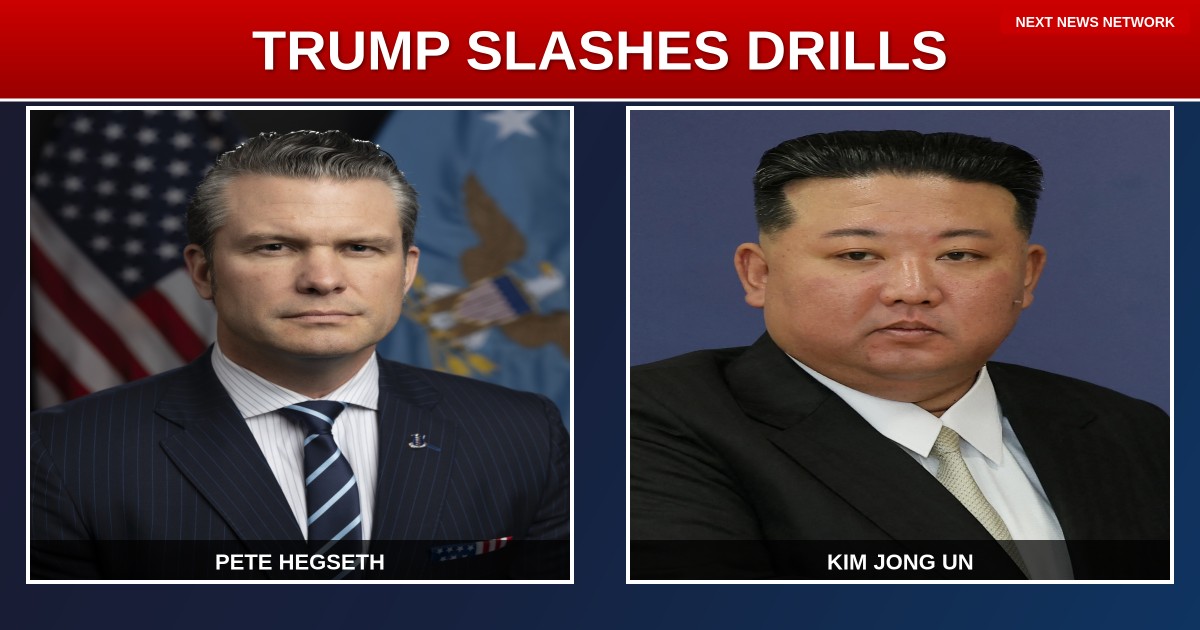
Barely into his second term, President Donald J. Trump has once again flexed his diplomatic prowess by instructing Secretary of Defense Pete Hegseth to 'substantially reduce' U.S.-South Korea joint military exercises. This bold move draws from his self-professed 'very good relationship' with North Korean leader Kim Jong Un and comes as Trump seeks to redefine the strategic landscape on the Korean Peninsula.
In a recent directive, Trump communicated that the longstanding military drills are 'inappropriate and hostile' towards North Korea, signaling a shift in U.S. foreign policy that prioritizes diplomatic engagement over military posturing. One tweet by @Anna033166 noted that Trump's decision underscores his belief in fostering amicable relations as opposed to 'pointless saber-rattling'.
Indeed, the decision has sparked a flurry of responses, with @Salavtoredamm pointing out that South Korea's Ministry of Defense has yet to respond adequately, especially given Seoul's lack of cooperation on the Iran denuclearization front. Trump's calculated step appears to nudge South Korea to step up on broader international denuclearization efforts.
@insanelycat highlighted Trump's argument about the financial burden of these exercises, pointing to his broader agenda of fiscal responsibility and military efficiency. Cutting costs while reducing tensions in a historically volatile area is seen as a win-win, consistent with the administration’s America First policy.
What's Next for the US-South Korea Alliance?
This decisive move has left geopolitical experts debating the future of U.S.-South Korea relations. Critics claim it undermines a traditional alliance and could embolden North Korea. However, MAGA supporters and many 'everyday Americans' view this as a brave step away from endless military involvement and towards genuine peace and stability.
"The legacy media will undoubtedly try to twist this as weakening our alliances," commented a senior White House official. "But the President has prioritized results over optics, and that's exactly what America needs."
By stepping back from overt military posturing, Trump continues to dismantle the establishment’s outdated strategies and replace them with pragmatic, results-driven diplomacy. The question remains: Will this be enough to ensure peace on the Korean Peninsula? As always, President Trump promises that the best is yet to come.