
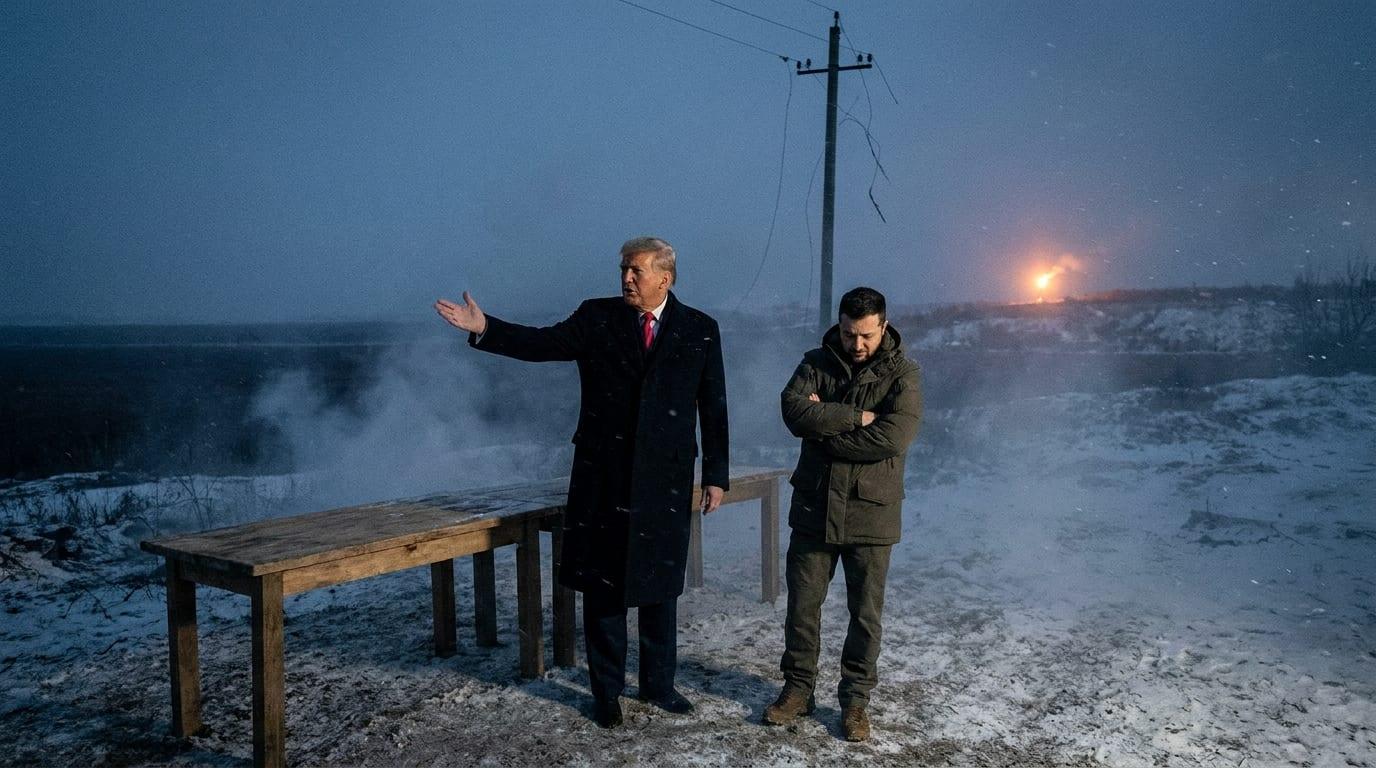
President Donald Trump announced Sunday that Russia and Ukraine have agreed to an immediate "energy ceasefire," a claim that spread rapidly across social media and drew an immediate pushback from Ukrainian President Volodymyr Zelensky.
"Effective immediately, there is an ENERGY CEASEFIRE in the War between Russia and Ukraine," Trump said, according to a statement carried by the account @clashreport. "Both parties have agreed. Do not break it! Thank you for your attention to this matter."
The announcement was amplified by the official White House account @WhiteHouse, which posted: "Effective Immediately: An ENERGY CEASEFIRE in the War between Russia and Ukraine." The message was repeated by the account @RealAmVoice, which attributed it to the president and carried the identical text.
The account @atrupar carried the statement in quotation marks, adding the signature line "President DONALD J. TRUMP."
The claim, as described by the account @MarioNawfal, suggests Moscow and Kyiv have agreed to halt attacks on each other's energy infrastructure. "Trump announces an immediate ENERGY CEASEFIRE between Russia and Ukraine," the account posted, quoting Trump's line: "Both parties have agreed. Do not break it!"
The account @GuntherEagleman framed the announcement as a breakthrough, posting: "ENERGY CEASEFIRE IN THE RUSSIA-UKRAINE WAR — EFFECTIVE IMMEDIATELY. Both sides agreed. Do NOT break it!" The post went on to say that Trump "just did what the experts, the neocons, and the endless-war crowd said was impossible," adding the phrases "Peace through strength" and "America First."
But the claim was not received as settled fact in Kyiv. According to Axios, Zelensky told the outlet that the announcement "was news for me." The Guardian reported that Zelensky said Kyiv would accept a deal if Moscow does, following a statement from the U.S. president that carried no detail on social media.
The reaction from Zelensky came after Trump had called for the Ukrainian president's replacement, according to CBS News. The outlet reported that Zelensky responded by saying Russia alone is responsible for the war in Ukraine.
Coverage of the announcement noted that neither Kyiv nor Moscow had confirmed the arrangement. Shafaq News reported that Trump said Russia and Ukraine had agreed to an immediate ceasefire covering attacks on energy infrastructure, "though neither Kyiv nor Moscow" had confirmed it as of its report. CBS News similarly described the announcement as a claim by the president, noting it came a day after he pushed for a new Ukrainian president.
The sequence of social media activity shows how quickly the claim moved from the president's statement to a broad network of accounts carrying it as breaking news. The message appeared first through accounts that relay statements from the president, then through the official White House account, and then through a widening set of accounts that repeated the language verbatim or summarized it as a historic development.
The posts did not include details on what the ceasefire would cover beyond energy infrastructure, how it would be monitored, or what consequences would follow if it were broken. The president's statement, as carried across the accounts, included only the directive not to break it.
Zelensky's response introduced a significant gap between the announcement and the public position of one of the two parties named in it. According to Axios, the Ukrainian president said the announcement was news to him. The Guardian reported that Zelensky indicated Kyiv would accept such a deal if Moscow did — a conditional position rather than a confirmation that an agreement was already in place.
The White House account's post carried the announcement without elaboration or supporting documentation. No joint statement from Moscow or Kyiv accompanied the claim in the material reviewed.
The announcement followed Trump's call for Zelensky's replacement, which CBS News reported as preceding the ceasefire claim. Zelensky's response that Russia alone is responsible for the war marked a direct counter to the pressure from Washington.
Next News Network could not independently verify that Russia and Ukraine have agreed to an energy ceasefire.
The posts carrying the claim did not cite a signed document, a joint communique, or a statement from Russian or Ukrainian officials. The accounts that spread the announcement relied on the president's statement as their source, and the official White House account repeated it without additional detail.
What the public record shows is a claim by the president, amplification by the White House and a network of accounts, and a Ukrainian president who said the announcement was news to him and who conditioned acceptance on Moscow doing the same. Whether an energy ceasefire is in effect, and whether both parties have actually agreed to it, remains unconfirmed by the parties themselves.
Our Take
Trump's announcement is the kind of move that drives the establishment mad: a direct, unambiguous claim that he has done what years of expert consensus and endless-war think-tankery said could not be done. The reaction from the usual quarters was immediate and predictable — Zelensky saying the announcement was news to him, the Guardian framing it as a claim rather than an agreement, CBS noting it as a statement rather than a settled fact.
But here is what the skeptics miss. Trump has a history of forcing facts on the ground by moving first and letting the momentum do the work. By announcing the ceasefire publicly and declaring that both parties have agreed, he has created a political reality that Moscow and Kyiv must now either embrace or openly reject. If they reject it, they own the escalation. If they accept it, Trump gets the credit. That is dealmaking, not naivety.
What the establishment cannot forgive is that it worked — or at least that it might. The same voices who spent years insisting there was no path to de-escalation are now scrambling to caveat the announcement into oblivion. Zelensky's conditional response — that Kyiv would accept if Moscow does — is not a rejection. It is a negotiating position. And the fact that the White House amplified the claim through official channels signals that this was not a random social media post but a deliberate move.
The American people should watch what happens next. If energy infrastructure attacks stop, Trump will have delivered where the experts failed. If they continue, the world will know who broke the deal — and it will not be the president who announced it.
