
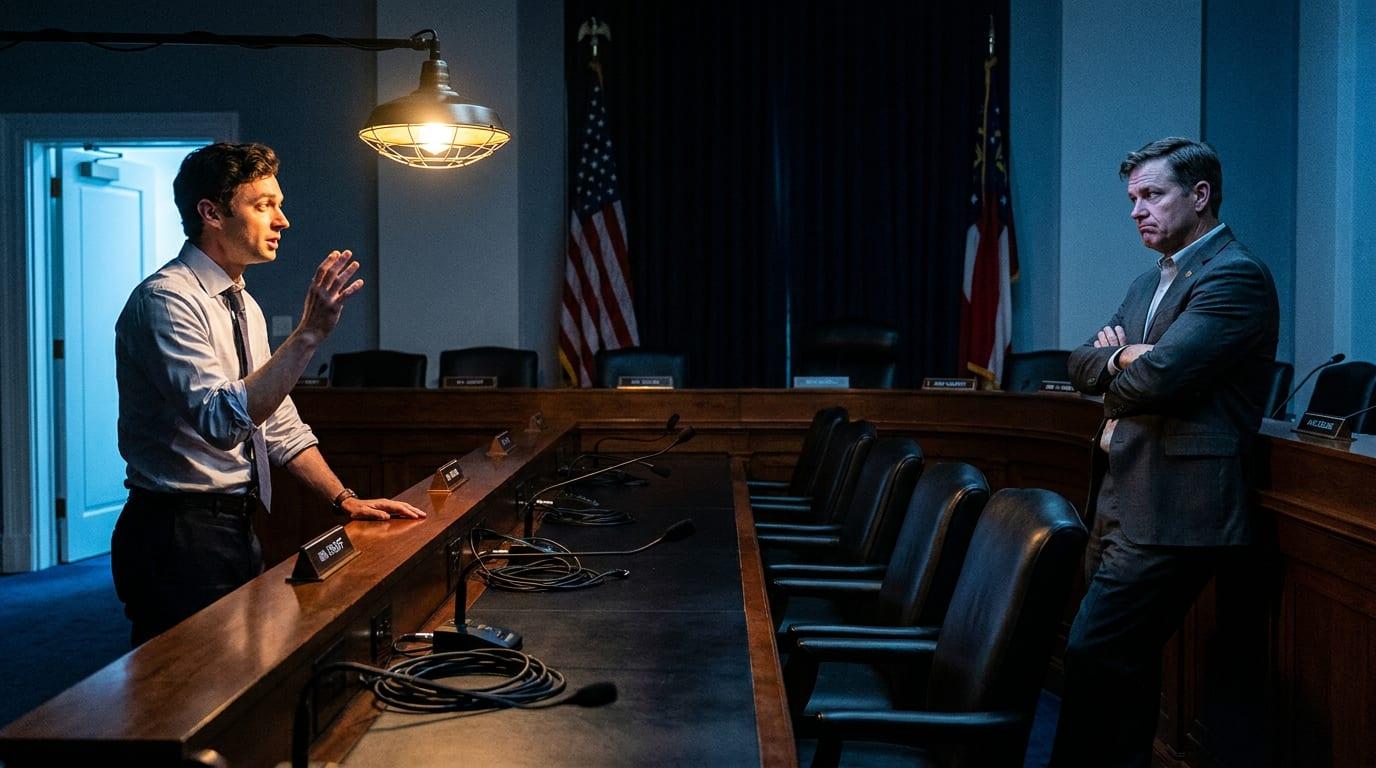
Sen. Jon Ossoff (D-GA) stood on a debate stage Tuesday night in Georgia and said the words his party's donors have been waiting to hear — and his Republican opponent has been daring him to say.
Pressed directly on whether he would commit to serving a full six-year Senate term if Georgia voters send him back to Washington in November, Ossoff answered, "Yes, I will," according to reporting from the Washington Examiner.
The pledge came during Ossoff's second debate against Rep. Mike Collins (R-GA), the Republican challenger in one of the most closely watched Senate races in the country. Washington Examiner reporter Samantha-Jo Roth reported that Ossoff was asked point-blank about the possibility of a presidential run and once again denied any 2028 ambitions.
POLITICO, which covered the same exchange, described the commitment as Ossoff's "most forceful rejection of 2028 rumors yet." That phrasing tells you everything about how long this question has been hanging over his campaign.
Ossoff has been floated for months as a potential Democratic presidential candidate in 2028 — mentioned in donor circles, in legacy media speculation, and in the perpetual horse-race coverage that treats every swing-state Democrat as a future White House contender. His refusal to rule out a run until now has been a quiet liability, letting Republicans argue he sees Georgia as a stepping stone rather than a job.
"I'm not running for president," Ossoff said during the debate, according to POLITICO, reiterating what his office has described as "zero interest" in a White House campaign.
The question now is whether Georgia voters believe him — and whether they should.
THE COLLINS CAMPAIGN'S ARGUMENT
Collins, a Republican who represents Georgia's 10th Congressional District, has framed the race around the contrast between a senator focused on his next job and a challenger focused on Georgia. The debate Tuesday also touched on the Jeffrey Epstein files, the 2020 election, and other flashpoints, according to the Washington Examiner's takeaways piece.
The six-year commitment matters most for one reason: it's the only concrete guarantee Ossoff can offer to voters who suspect his real ambition lies elsewhere. Every Senate candidate faces this question. Few face it with the kind of national profile Ossoff has cultivated — and few have spent as long leaving the door visibly cracked.
Republicans argue the timing is suspect. The pledge came not in a press conference, not in a sit-down interview, but on a debate stage in October, weeks before an election, with polls tightening and a Republican challenge gaining traction. That's not conviction, his critics say — that's political triage.
Democrats, for their part, will point out that Ossoff has consistently denied presidential ambitions. The problem is that "denying" and "committing" are different things, and it took a Republican opponent and a direct debate question to get from one to the other.
WHAT'S ACTUALLY AT STAKE
Georgia is the only state where a Democratic senator is running for reelection in a state President Donald J. Trump won in 2024. That makes Ossoff the most vulnerable Democratic incumbent in the country — and it makes every answer he gives on that debate stage a test of whether he can hold together the coalition that sent him to Washington in the first place.
The 2028 speculation has been a gift to Collins. It allows the Republican to run against Ossoff's ambition rather than his record, and it forces the incumbent to spend precious debate time explaining what he isn't going to do instead of what he has done.
Tuesday's answer won't end the speculation. Nothing does — ask any senator who has ever been asked this question. But it does put Ossoff on record, on camera, in front of Georgia voters. If he breaks that pledge, the clip will follow him for the rest of his career.
Our Take
Let's be honest about what just happened. Jon Ossoff didn't suddenly discover a deep love for the six-year Senate term. He got asked a question he couldn't dodge on a stage he couldn't control, and he gave the only answer that wouldn't have ended his campaign on the spot.
This is a politician who has spent years letting the national press treat him like a rising star — because he is one, in their eyes. He's young, he's telegenic, and he's from a state Democrats desperately need. The 2028 whispers weren't an accident. They were an asset, right up until they became a liability.
So what changed? Mike Collins got in the race. The polls got close. And suddenly the man who had "zero interest" in the White House found himself pledging to serve all six years — out loud, in a debate, with cameras rolling.
That's not a conversion. That's a calculation.
Georgians should ask themselves a simple question before they vote: If the national media hadn't spent two years floating his name for president, would Ossoff have ever felt the need to make this promise at all? Or would he have kept quiet, kept his options open, and kept using the Senate seat as a launchpad?
We know the answer. So do the donors who have been courting him. The only people who don't seem to know it are the Georgia voters he's now asking to trust him for six more years.
The pledge is welcome. But a pledge extracted under political pressure is not the same as a promise made freely — and the man who made it has a lot of explaining to do between now and November.
