
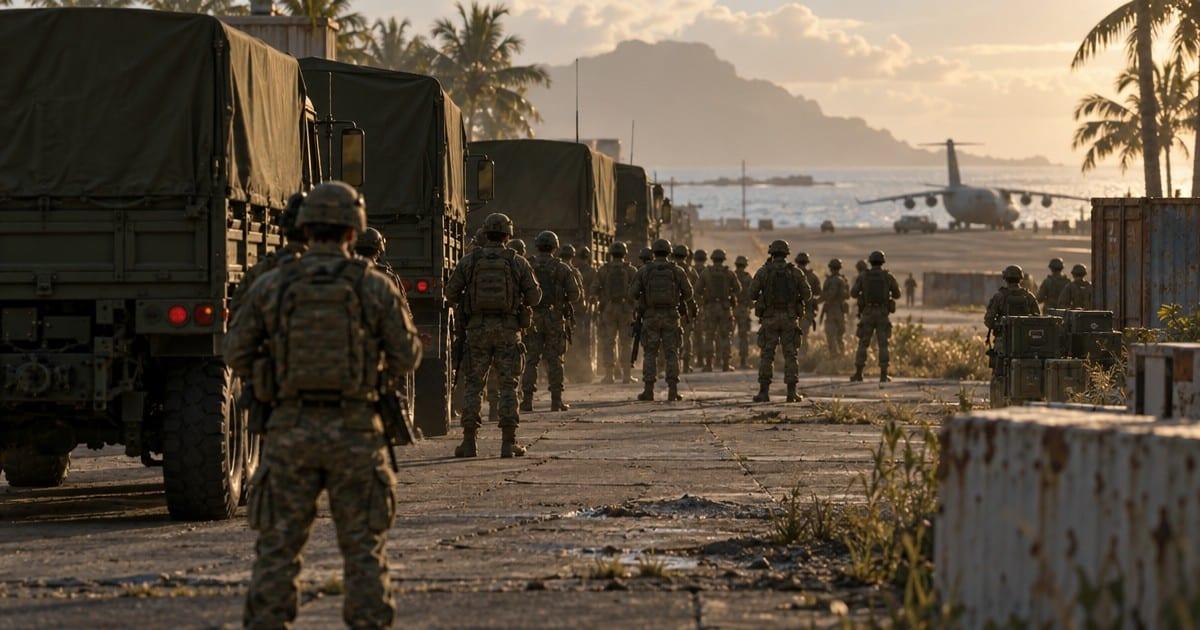
El Salvador has reportedly sent around one thousand troops to Haiti in response to an ongoing situation following a gang ambush near Port-au-Prince that involved missing Salvadoran personnel, The Washington Times reported Wednesday afternoon.
The Washington Times, an outlet with roughly four hundred ninety thousand followers, attributed the figure to reporting on the deployment. The post described the movement of troops as a response to "an ongoing situation" tied to the ambush, in which Salvadoran personnel were reported missing.
The claim circulated widely across outlets in the hours and days that followed. CBC News reported that El Salvador had sent about one thousand troops to Haiti after four Salvadoran members of a UN-backed force went missing during a gang ambush on the outskirts of Port-au-Prince, citing a security official in Haiti who spoke to Reuters. US News carried a similar report under the headline that around one thousand soldiers from El Salvador had deployed, citing a source. Bloomberg reported that El Salvador's troop presence in Haiti had swelled to at least six hundred, according to a top researcher, describing the buildup as a reflection of President Nayib Bukele's efforts to find four kidnapped soldiers.
Another report described El Salvador continuing to deploy soldiers and equipment to Haiti as gangs threatened violence, and placed the ambush on October 18 in gang-controlled territory east of Port-au-Prince, noting that the missing men were members of the Salvadoran armed forces deployed under the United Nations-authorized Gang Suppression Force in Haiti and that they remained unaccounted for.
Taken together, the coverage describes a rapid military movement toward the Caribbean nation at a moment of acute tension for the Salvadoran government, which has staked significant international standing on its security partnership in Haiti. The accounts differ on scale — with figures ranging from at least six hundred troops to roughly one thousand — and on sourcing, with some outlets citing a Haitian security official and others citing a researcher or an unnamed source.
The Washington Times post was among the earlier items to carry the figure, framing the deployment squarely around the missing personnel. The post did not name the official who provided the number, and it did not describe the circumstances of the ambush beyond calling it a gang ambush near Port-au-Prince.
Subsequent coverage filled in elements of the sequence. The men were ambushed on October 18, according to the report on continuing deployments, in territory controlled by gangs east of the capital. They were serving under the UN-authorized Gang Suppression Force, the multinational mission authorized to assist Haitian authorities against armed gangs. Four Salvadoran members of that force went missing during the ambush, according to the CBC report, which attributed the detail to a security official in Haiti speaking to Reuters.
The Bloomberg report introduced a competing estimate of the troop presence, describing it as at least six hundred and attributing that figure to a top researcher. That estimate, if accurate, would place the deployment below the roughly one thousand figure carried by The Washington Times and other outlets, though the two numbers are not necessarily in conflict: a buildup can pass through six hundred on its way to a larger total, and different sources may be counting different categories of personnel. Neither figure has been independently confirmed.
What the coverage makes clear is the direction of the Salvadoran response. Under President Nayib Bukele, El Salvador has built an international profile around its domestic security crackdown and has extended that posture into Haiti through participation in the UN-authorized force. The disappearance of Salvadoran personnel in gang-held territory east of Port-au-Prince appears to have prompted a significant escalation in that participation, with multiple outlets describing reinforcements and equipment moving toward the country.
The reports also converge on the location and date of the ambush. The October 18 date and the description of gang-controlled territory east of the capital appear in the coverage of continuing deployments. The CBC report places the ambush on the outskirts of Port-au-Prince. The Washington Times post describes it as near Port-au-Prince. None of the accounts reviewed provided a detailed account of how the ambush unfolded or the current status of the missing men beyond describing them as unaccounted for.
The story has moved through a range of outlets in a short span, from The Washington Times and CBC News to Bloomberg and US News, each carrying a version of the deployment claim. The spread across outlets with different sourcing — a Haitian security official, a researcher, an unnamed source — is itself notable, because it means the same core claim is being repeated through several channels that are not all relying on the same origin point. That pattern can reflect independent confirmation, or it can reflect a single claim traveling through multiple retellings.
The four missing Salvadoran personnel remain at the center of the story as described in the coverage. They were deployed under the UN-authorized Gang Suppression Force, and they went missing during the October 18 ambush. The deployment of reinforcements is described across the coverage as connected to the search for them and to the broader deterioration of security around the capital.
Next News Network could not independently verify the reported deployment or the figure of approximately one thousand troops.
Our Take
The reporting here matters for two reasons, and conservatives should pay attention to both. First, a Salvadoran president sent his soldiers into a gang-controlled failed state under a UN authorization, four of them went missing in an ambush, and his answer was to send more. That is what sovereignty in the Western Hemisphere looks like when a leader treats his men as something worth risking to retrieve. Compare that posture to the hesitation that has marked so much of the response to Haiti's collapse from larger powers.
Second, the way this story is traveling deserves scrutiny. The Washington Times carried the figure early, and within a day it was in CBC, Bloomberg, and US News, each with a slightly different source and a slightly different number. That is how a claim becomes a fact in the public mind before anyone has confirmed it on the ground. The outlets carrying it are not all citing the same official, which means readers should treat the specific troop count as an estimate until something firmer emerges. The direction of the deployment is the story; the precise arithmetic can wait.
What is not in doubt is the stakes. El Salvador has chosen to stand with the forces trying to pull Haiti back from gang rule, and it has now reportedly paid a price in missing men and answered with reinforcements. That is a commitment worth watching, and a government worth holding to its word about bringing those four soldiers home.
