
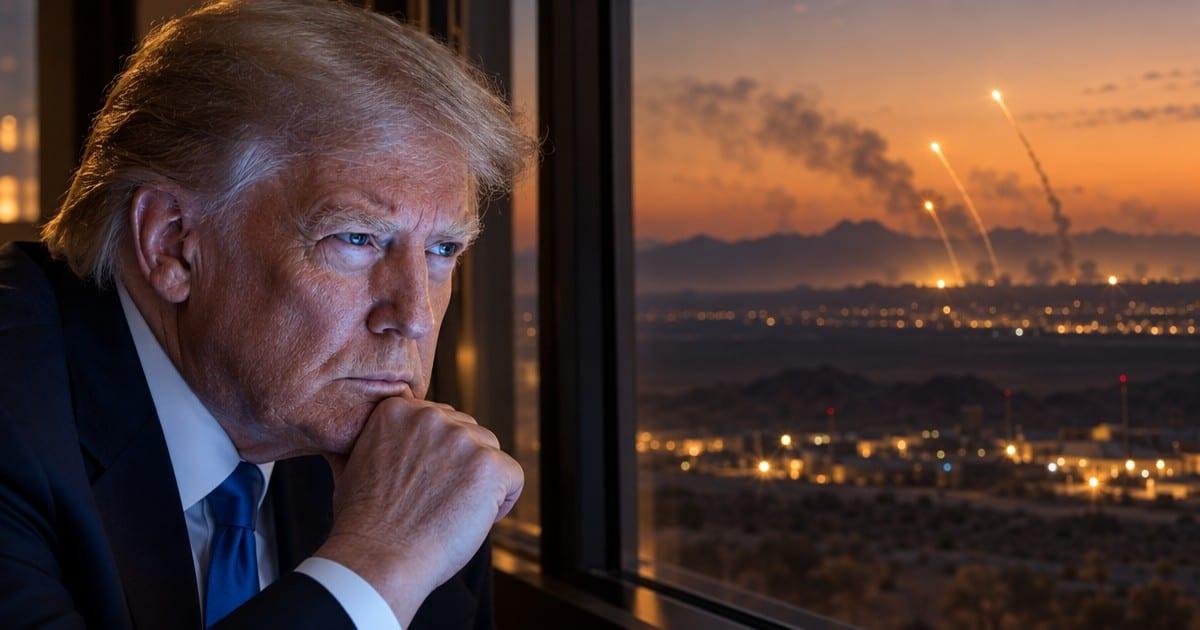
Saudi Arabia's vaunted military machine is failing to stop the Houthi barrage, and President Donald Trump is now weighing whether to send American forces directly into the fight in Yemen.
The kingdom has spent decades and tens of billions building one of the region's most sophisticated militaries. Last year alone, Riyadh spent an estimated $83.2 billion on defense, making it the eighth-largest military spender in the world, according to the Stockholm International Peace Research Institute. Its arsenal includes U.S.-made F-15 fighter jets, Patriot missile defenses and advanced radar systems.
None of it has been enough. Houthi strikes and attempted strikes on the kingdom more than doubled in a single week this month, according to the Armed Conflict Location & Event Data Project. Airports in Riyadh, Jizan, Najran, Dammam and Abha have been targeted since Oct. 5. The most devastating attack struck King Khalid International Airport in Riyadh, killing at least 13 people and wounding more than 300.
An American citizen was among the dead. The U.S. embassy in Saudi Arabia has been issuing near-daily alerts to Americans traveling in the country, advising them Monday to "be aware of potential attacks on airports, airspace closures, flight cancellations, and travel disruptions" and to "take extreme caution if you choose to use airports in Saudi Arabia."
The threat is no longer confined to the kingdom. The Trump administration now assesses that Houthi attacks pose a broad, escalating threat to Americans across the Middle East, prompting the State Department to issue urgent warnings about the Iranian-backed rebel group across a dozen countries in the region, U.S. officials told ABC News. Embassies in Bahrain, Iraq, Israel, Jordan, Kuwait, Lebanon, Oman, Qatar and the UAE issued coordinated security alerts Sunday, advising Americans that hostilities involving Houthi militants "have the potential to escalate rapidly."
"We are actively warning U.S. citizens about the very real threat the Houthis pose and urging them to heed official guidance. These alerts are part of a proactive effort by the Trump administration to ensure Americans are aware of potential risks," State Department Deputy Assistant Secretary for Press Edgar Vasquez said in a statement to ABC News.
Britain announced Tuesday it would send Typhoon fighter jets to defend Saudi cities and critical infrastructure. Egypt is already assisting the kingdom, and Israel has offered to help. Riyadh is asking Washington for more interceptors.
"The theme right now, I think, is defensive or defensive-minded," Jason Campbell, a senior fellow at the Middle East Institute, told Fox News Digital. The reinforcements, he noted, do little to eliminate the Houthi launchers and weapons threatening Saudi Arabia from Yemen.
Campbell said the U.S. and its regional partners had been comparatively well prepared to confront the higher end of Iran's arsenal, including ballistic missiles and other advanced weapons. "What the region was decidedly less prepared for was an array of lower end of the spectrum," he said.
The economic fallout is already visible. Saudi Arabia postponed a major annual investment conference commonly referred to as "Davos in the Desert" due to the security environment. Other attacks have targeted Saudi energy infrastructure, turning the Houthi campaign into a threat not only to the kingdom's security but to the economic stability Riyadh has spent years trying to project.
Trump is now weighing whether the U.S. should intervene and strike the Iran-backed Houthis directly. Saudi-led air and ground operations against the Houthis in Yemen have not curtailed incoming attacks.
Our Take
Here is what the establishment crowd will not tell you: this is what happens when you spend eight years of the Obama and Biden administrations treating the Houthis as a nuisance rather than an Iranian proxy army. The Houthis did not build this arsenal in a cave. They built it with Iranian components, Iranian training and Iranian money while the world's supposed experts looked the other way.
Saudi Arabia's military is not a paper tiger, but it is a defensive one. Its Patriot batteries and F-15s were built to swat down the high-end threats from Tehran's ballistic missile program. They were not built to stop swarms of cheap drones and crude missiles launched from mountain hideouts by a militia that has no air force and no navy and still manages to shut down airports and scare off billion-dollar investment conferences.
Now the bill for that failure lands on Trump's desk. The American people did not vote for another Middle East forever war, and they should not get one. But they also did not vote for American citizens to be killed in Saudi airports and for the State Department to issue emergency alerts across a dozen countries because the Houthis have figured out that Washington lacks the will to finish them.
The solution is not a massive ground invasion or nation-building in Yemen. It is the kind of overwhelming, targeted retaliation that the Trump administration has used to take out terrorist leaders before. If the Houthis strike again and kill another American, they need to understand that the response will not be another strongly worded alert. It will be the destruction of their launch sites, their stockpiles and the commanders who ordered the attacks.
But here is the question every patriot should be asking: why is it Saudi Arabia's defense, and Britain's Typhoons, and Israel's offer of help that are filling the vacuum while the United States hesitates? Trump promised strength and he has delivered it before. Americans overseas deserve to know that when the Houthis come for them, the full might of the United States is coming for the Houthis first.
